

The Definitive Guide to SAP S/4HANA® for Fashion and Vertical Business
SAP has put real-time business within reach of fashion retailers with the introduction of SAP S/4HANA for Fashion and Vertical Business.
This next-generation platform combines the lightning-fast analytics of SAP HANA with transactions, enabling fashion retailers to gather and process data across wholesale, retail and manufacturing, while simultaneously applying it to consecutive business process – all in real time.
Below, we’ll go over many SAP S/4HANA Fashion use cases to give you a clear picture of how incorporating a real-time digital core for fashion is the best way forward.
Here’s your roadmap for the rest of this guide. As we move along, we’ll stop off at each point to dig in a bit deeper.
Roadmap to the Definitive Guide to SAP S/4HANA for Fashion and Vertical Business
- How does SAP S/4HANA deliver a digital core required for the digital economy?
- What does SAP S/4HANA Fashion mean for apparel, fashion and footwear companies?
- Why move to S/4HANA Fashion: Scope, Functionality and Benefits
- Delving Deeper: SAP S/4HANA Fashion Use Cases
- What considerations are there for migrating to SAP S/4HANA Fashion Retail?
- How can companies migrate to SAP S/4HANA Fashion faster?
- Manage S/4HANA Risks with a Future Reference Solution
- SAP S/4HANA Frequently Asked Questions
- Parting words: Why act now?
1. How does SAP S/4HANA deliver a digital core required for the digital economy?
Businesses now understand that overly complex business operations and IT systems create significant limitations in performances and agility. In fact:
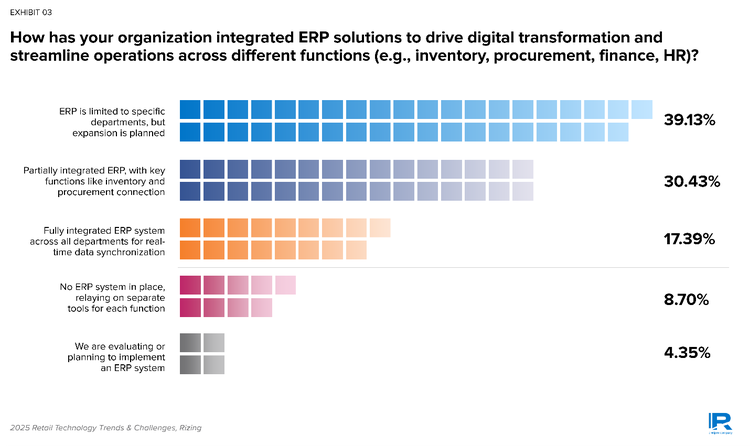
- Only 17% of retailers have fully integrated ERP systems across all departments, leaving most organizations struggling with silos and inefficiencies.
- Nearly 60% are still working on improving their analytical capabilities to anticipate market trends, underscoring the need for real-time insights.
- Only 15% feel fully equipped for direct-to-consumer and multichannel selling, revealing gaps in omnichannel readiness.
Overcoming complexity in fashion is not a “to-do” item that can easily be checked off. Rather, it involves a strategic company-wide approach with a singular goal: drive digital transformation into fashion by leveraging a robust digital foundation that places simplicity at the core of the business.
Transformation Requires a Digital Core
Ask a CIO which technologies a company must have to “digitally transform” the organization, and you’ll probably hear about internet of things (IoT) or machine learning. But these technologies can’t work their best on traditional, monolithic IT landscape or legacy ERP data structures.
This is where a digital core comes in. A digital core is crucial to a digital transformation initiative offering stability and long-term reliability for core enterprise processes with a single source of truth. This solid foundation gives you a higher degree of flexibility to adapt and innovate quickly to new opportunities and challenges, such as new business models, new regulations and business events such as mergers or acquisitions.
A digital core brings together transactional processes and analytics on a single platform to deliver real-time intelligence with immediate, tangible benefits.
For fashion companies, this means using a platform that connects across all sales channels – wholesale, retail, manufacturing and e-commerce, empowering decision-making and giving you a significant advantage in today’s digital economy.
As seen in the 2025 Retail Technology Trends survey, only 17% of retailers have fully integrated ERP systems, while nearly 40% report limited integration across business functions.
However, moving to digitally connected core is not a small, incremental change. Enterprises that treat it as such will fail to succeed. Building a digital business brings about fundamental changes, with new business models that involve major shifts in how an enterprise operates and interacts. The key to thrive and surviving in the digital era is managing data, but this can’t be sustained efficiently without a revamped digital core that includes stable and reliable core ERP processes.
SAP S/4HANA Delivers
SAP S/4HANA delivers on this promise by creating a functioning digitalization-friendly IT environment. Within this landscape, all its applications are interconnected, making it possible to access and use detailed data from anywhere within the company in real time without information loss.
How does a digital core on SAP S/4HANA with a true single source of truth help?
- Speed: Perform real-time planning, execution, reporting, and analytics based on live data
- Agility: Access real-time business insights on any device, anytime, anywhere
- Simplicity: Deal with both transactional and analytical workloads simplifying your IT landscape
- Cost efficiency: Reduce TCO by combining analytics and transactions
- Innovation: Find new growth opportunities by rethinking business processes and enabling the business platform for mobile devices
2. What does SAP S/4HANA Fashion mean for apparel, fashion and footwear companies?
Now that you know that large, monolithic ERP suites are not conducive to the agility required for digital business, let’s take a closer look at what SAP S/4HANA for Fashion is. We’ll show how it delivers a digital core to power operations, modernize the operational core, and help retailers meet the demands of omnichannel retailing.
What is SAP S/4HANA for Fashion and Vertical Business?
SAP S/4HANA Fashion is a comprehensive ERP solution, designed to help fashion businesses meet the demands of the digital economy.
With a simple and intuitive interface, it provides fashion companies with access to every aspect of their business, merging all fashion processes - wholesale, retail, manufacturing and e-commerce into a single platform. The vertical fashion platform gives retailers the flexibility and agility needed to deliver seamless customer experiences.
Real-time Reporting
Retailers can use it easily adjust to rapidly changing business requirements and report in real time by:
- Function
- Region
- Category
- Channel
- Product
Designed to place real-time business within reach of fashion companies, SAP S/4HANA Fashion combats complexity, streamlines digital transformation, and provides the ultimate simplicity.
Supports Reinvention
Supporting fashion core processes end-to-end, from master data to supply assignment, the redesigned business suite provides previously unavailable agility and flexibility designed to support innovative digital business initiatives.
Fashion companies can reinvent their business from front office to back office, gain insights into operational data, and empower their employees with contextual, real-time information for faster and better decision making.
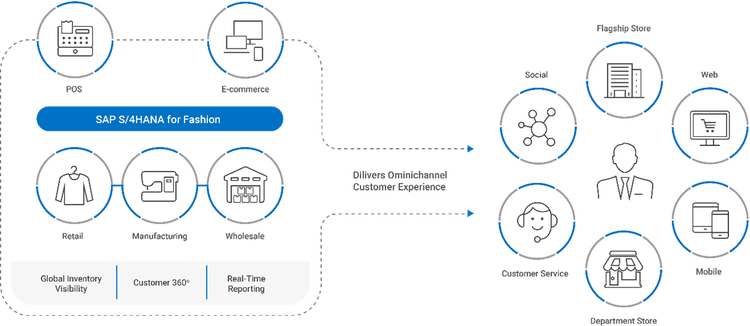
What does SAP S/4HANA mean for fashion businesses?
Businesses are able to interpret information flowing in and out of the business. They can take their processes digital based on a single source of information that interconnects all aspects of the value chain in real-time.
- Supports Seasonality
Many companies sell products according to the season. Their main objective is to avoid having stock left-over at the end of the season.
From planning, procurement, sales, online and offline channels through to coordinated clearance sale campaigns, vertical integration on SAP S/4HANA for Fashion ensures that these processes are fully harmonized, whether the products are being sold in a department store or in a flagship store.
- In-Memory Nerve Center
This entirely new business suite runs on the SAP HANA in-memory database technology to give end users real-time decision support. It moves away from the transactional ERP system and becomes the nerve center (digital core) of your entire fashion enterprise.
- Developed natively on the SAP HANA® platform for real-time data processing and analytics, coupled with best practice fashion functionality for a live understanding of customers, inventory, and sales
- Offers global inventory visibility, common sourcing, buying, and manufacturing with capabilities for stock segmentation across channels
- Delivers omnichannel supply assignment and fulfillment based on real-time sales and inventory information to keep up with customers’ expectations across sales channels
- “Industry to core” means one platform that unites various industry solutions for potential synergies and cross-scenarios
- Single set of master data that simplifies processes in key areas such as inventory management and stock valuation with no more batch processing required
- Easily connects to people, devices, and business networks to deliver new value to their customers on any channel, which means the Internet of Things and Big Data become accessible to any business
- Create a truly live business with immediate insights to act in the moment and intelligent processes that go beyond automation to predictive suggestion and complete integration between your departments and verticals
- Gain any insight on data from anywhere in real-time to plan, execute, predict, and simulate with all decisions able to be made on the fly with the most granular data for faster business impact
- Dramatically simplify the landscape and reduce TCO
- Use a simple and role-based user experience based on modern design principles across all functional areas, allowing new ways of working for business users, minimizing training efforts and increasing productivity
- Simplified User Experience
The value from a SAP S/4HANA Fashion Digital Core is delivered through the simplification of the user experience, architecture, and business processes. This helps retailers better analyze trends, simulate the outcomes of strategic options, and optimize planning. Fashion companies now have the ability to create unique opportunities to reinvent business models and drive new revenues and profits.
Call out box
Move away from fragmented or home-grown, custom solutions in favor of SAP S/4HANA for Fashion because:
- It’s more complex to build and deploy a custom application suite than to implement standardized ERP platform such as SAP S/4HANA for Fashion
- Large scale internal development projects typically take longer to deliver value to the business, whereas rapid deployment solutions built for SAP S/4HANA for Fashion accelerates the implementation timeline with a preconfigured template
- It’s difficult to update and extend the custom application to respond to market trends, customer expectations, management requests, and changes in technology. SAP S/4HANA for Fashion uses the latest technologies to connect your workforce, suppliers, consumers and the internet of things in real-time to capture every opportunity and customer demand signal
3. Why Move to SAP S/4HANA Fashion: Scope, Functionality and Benefits
Fashion companies must be ready to service their customers at any given moment with:
- The right information
- The right product
- In the right location
- At the right price
The capabilities delivered with SAP S/4HANA for Fashion and Vertical Business and its many integration points into complementing retail solutions help ensure fashion companies deliver on this promise across the customer engagement lifecycle.
Let’s take a look at how this is possible with an overview of SAP S/4HANA benefits, functionalities and scope.
-
Row 1
- Duplication of Effort / Lack of Integration
-
Row 1
- Pain Points
- Solution on SAP S/4HANA
-
Row 1
- Lack of integration across multiple systems results in extra work, requiring manual processing and maintenance of data in Excel.
- Work with larger data sets in one system, merging retail, manufacturing, and wholesale data in a single ERP with tight integration to related systems such as CRM, PLM, etc.
-
Row 1
- Different data models, data dictionaries, different languages, and duplicate data drives lowers reliability of any given data set.
- Removes data discrepancies, reduces data footprint, and eliminates redundant data entry/processing tasks, drastically lowering data manipulation errors.
-
Row 1
- Data latency results in wider margins of error, delays, and bottlenecks - like inability to replenish stocks fast enough to meet real-time demand across channels.
- Enterprise-wide access to a single source of truth for decision-making in real-time.
-
Row 1
- Inventory Management
-
Row 1
- Pain Points
- Solution on SAP S/4HANA
-
Row 1
- Stock information is spread across numerous tables, channels, and locations. It's difficult to consolidate slow, non-transparent processes that require manual work or cumbersome interactions between applications.
- Inventory information is stored in general journal tables for simple and live stock reporting.
-
Row 1
- Stock is available for consumption across all locations regardless of priorities.
- With stock protection, companies can reserve stock for high-priority channels.
-
Row 1
- Mission-critical core processes such as allocation or calculating available-to-promise quantities can only be run at night.
- Allocation processes (supply assignment) and ATP runs are accelerated by using in-memory computing technology.
-
Row 1
- Manual/Non-Systemic Processing
-
Row 1
- Pain Points
- Solution on SAP S/4HANA
-
Row 1
- Manual workarounds are often needed in an attempt to merge key data to conduct daily work.
- Fact-based, timely decision-making with accurate data available without replication or delay.
-
Row 1
- Merchandising decisions often based on intuition rather than accurate data.
- Improved system capabilities reduce the need for external systems.
-
Row 1
- Data issues, latency, inconsistencies, or problems feeding information across systems results in rework, reprocessing, or overrides.
- Limited workarounds or system customizations. Use of supported extensions for non-standard functionality.
-
Row 1
- Season Management
-
Row 1
- Pain Points
- Solution on SAP S/4HANA
-
Row 1
- Master data management does not consider seasonal windows.
- New seasonality concepts drive all processes of an article along its lifecycle from master-data creation to sales.
-
Row 1
- Season Management
-
Row 1
- Provides limited support for seasonal handling, informed decision-making, or analysis of what products or styles perform best.
- Distribution curves help fashion and seasonal businesses achieve the right mix of styles to maximize revenue opportunity.
-
Row 1
- Control logistical processes like sales and purchasing based on seasonal parameters.
-
Row 1
- Supply Chain Planning
-
Row 1
- Pain Points
- Solution on SAP S/4HANA
-
Row 1
- Separate planning for individual channels.
- Single system for planning and allocation with a joint purchasing process that handles higher order quantities under better ordering conditions with the suppliers.
-
Row 1
- Long and overnight batch run processes and lack of overall inventory visibility results in inefficient planning and permanent latency in inventory turnover reporting.
- Unified demand insights and forecasts across functional areas.
-
Row 1
- Inflexibility to include real-time changing demands in the planning run leads to outdated and inaccurate planning.
- Increased flexibility in stock usage like shifting leftover stock between channels when necessary, reduces out of stock situations and increases profitability.
4. Delving Deeper: SAP S/4HANA Fashion Use Cases
Moving to SAP S/4HANA may seem complicated but the benefits of speed, flexibility and cost savings are clear.
As a close collaborator on the development of the SAP S/4HANA for Fashion and Vertical Business, Rizing was heavily involved in the acceptance testing of the product. As a result, we’re often asked about the motivation for SAP S/4HANA for Fashion. The value is clear, but we thought it is best explained via concrete SAP S/4HANA use cases.
Below we take a look at some specific scenarios:
01. Advanced ATP
In traditional systems, conventional Available-to-Promise (ATP) is a function provided to help fashion businesses confirm order delivery dates based on actual supply chain and manufacturing resources. ATP provides this confirmation by analyzing data like warehouse stock, planned orders, and sales orders to ensure that future orders do not disrupt confirmed orders.
Although easy to use, the increased complexity in today’s digital world requires more complex mechanisms, leaving conventional ATP insufficient. For example, availability checks were done on a first-come, first-serve approach, which kept businesses from meeting their strategic priorities.
To cope with these changes, SAP introduced Advanced Available-to-Promise (aATP) on SAP S/4HANA Fashion to address the challenge of working in a dynamic environment. This allows fashion companies to react to changes in the supply chain and help manage demand and supply intelligently by ensuring optimal assignment of supply.
02. Stock Protection
Fashion companies and vertical businesses often sell through a multitude of channels. However, not all the orders are placed at the same time.
Important customers may place orders late, so it’s important to protect stock for them. S/4HANA Fashion and Vertical Business offers a powerful and integrated stock protection mechanism to ensure that fashion companies don’t lose their most valuable customers.
Stock Protection on SAP S/4HANA for Fashion works by prioritizing demand plans during the sales cycle. Unpredictable problems like increased demand can lead to critical situations in order processing, which ideally should be prevented before they arise.
Fashion companies must prioritize customers, channels, or markets to serve the most important customers first. Stock protection helps companies by protecting inventory for high priority demand even if important sales orders are received late and low priority orders precede them.
For example, a fashion company has retail, e-commerce, and wholesale sales channels. Ecommerce is priority 1, retail as priority 2, and wholesale as priority 3 as below:
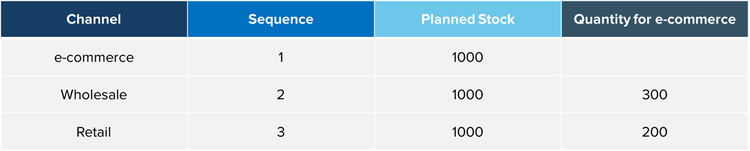
If e-commerce does not have sufficient stocks, it can consume 300 units from wholesale and 200 units from retail to ensure demand from profitable channels are always met.
Referred to as Horizontal Stock Protection, this protects channels from cannibalizing each other in order to balancing stock for a profitable outcome.
Fashion retailers can use the same functionality to ensure stock protection for a channel or channel + customer combination, with business rules to ensure other channels can’t consume or poach its stock. This method, referred to as vertical stock protection, protects stock for high priority channels, and is useful if you want to ensure the success of a critical sales channel, even if less important ones are repressed.
03. Backorder Processing
With the newly revamped Back Order Processing (BOP) on SAP S/4HANA, fashion companies can check stock availability after changes in the demand or supply during order fulfillment process and reconfirm if previously calculated confirmations for sales orders or stock transport orders are still realistic.
Back Order Processing on SAP S/4HANA for Fashion uses five different predefined confirmation strategies (business rules) to minimize losses due to inventory stock-outs, protect customer interests, and ensure strategic customers always get served.
- Win: Shall be fully confirmed in time (the most important customer orders)
- Gain: Shall keep the confirmations and should gain if possible
- Redistribute: Might gain, might lose (orders that can lose confirmations)
- Fill: Shall not gain anything, should keep confirmation, but may also lose (non-priority customer orders)
- Lose: Shall lose all confirmations (orders under credit block)
Example:
A last-minute customer order is created for a very strategic customer. However, the stock has already been committed to another customer, belonging to a lower confirmation hierarchy, leaving no stock available for the priority customer.
After executing the back-order processing, stock previously committed to sales orders with customers classified as REDISTRIBUTE, FILL and LOSE has shifted to the customer classified as WIN.
04. Demand and Supply Segmentation
Fashion companies today face intense competition in an increasingly customer-centric global market.
It’s important to streamline internal processes and logistics around the unique requirements of each market through appropriate sourcing, planning, and supply of goods.
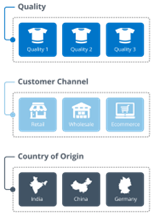
To help fashion brands manage demand and supply better, Demand and Supply Segmentation on SAP S/4HANA Fashion categorizes stock logically, based on specific criteria. Using segmentation on SAP S/4HANA for Fashion, you can order materials of different quality levels, for different customer channels, and from different countries of origin. This way, you can easily manage supply with greater visibility into stock, separated by channels.
Some of the key benefits include:
- Easily meet the unique requirements specific to the fashion industry
- Implement rules to segment stock with predefined logical characteristics such as retail or wholesale sales channels or physical characteristics such as quality grade or country of origin.
- Use these characteristics during other processes such as order promising and order allocation
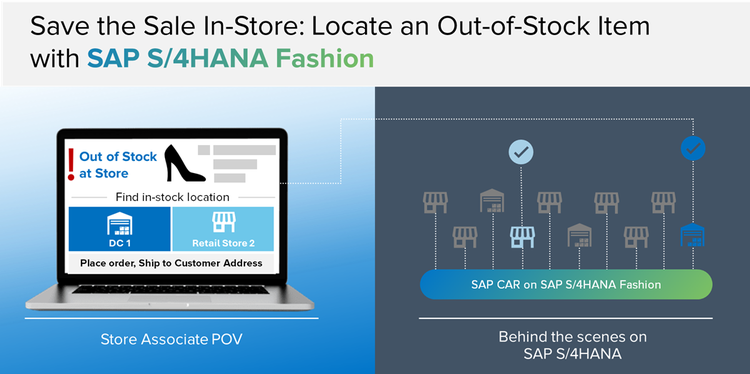
05. Endless Aisle: Fulfilling Out of Stock Products
Historically, if a customer placed an order for a product not in stock, the order would be cancelled or placed on hold until the item was restocked. However, when SAP S/4HANA Fashion is connected to your POS and e-commerce system, if an order for an out of stock product is placed, then inventory visibility allows to still fulfill that order from another location where the item is in stock, including inventory held in other channels.
This functionality can be used across all sales channel. In doing so, fashion retailers can maintain adequate in-stock quantities while eliminating duplicate safety stock, which legacy systems held separately in each inventory pool that often resulted in excess safety stock.
For example, a customer in a brick-and-mortar store wishes to purchase a pair of boots but the store doesn’t have her size. Via an in-store kiosk or POS, the sales associate is then able to fulfill the demand with the right size in stock by routing the order to be fulfilled from the warehouse or a nearby store.
Building an SAP S/4HANA for Fashion and Retail Business Case
Most SAP customers understand that technology has advanced and know that they have to modernize to achieve the greater speed and flexibility demanded by the industry today. However, it’s not a simple decision to move as this change comes with heavy costs.
The move to SAP S/4HANA won’t make sense if companies simply look at it from a technology cost perspective. Companies must build a business case by looking at the value they will gain from the business benefits that SAP S/4HANA Fashion Retail will provide.
The key is fashion companies that move to this next generation technology will have real-time data to make decisions faster and better satisfy customers.
5. What considerations are there for migrating to SAP S/4HANA Fashion Retail?
For fashion companies looking to implement SAP S/4HANA for Fashion or Retail, the project may seem complex and costly. This is especially the case for companies that may have multiple disparate SAP systems and processes across their global operations.
To help, we’ve put together some insights to industry leaders looking to transform their operations with a digital platform.
01. Considerations for Building a Global Template for SAP S/4HANA Rollouts
Brands, retailers, and manufacturers implementing SAP S/4HANA cloud ERP recognize that a new digital core will unify systems and processes across their global operations, create efficiencies, improve visibility, and introduce standards across geographies.
While the benefits are compelling, a global SAP S/4HANA Fashion rollout is a massive and complex undertaking. It involves a spectrum of “moving parts” before, during and after go-live.
It’s crucial that a company stages and executes the implementation in a manner that provides the right balance between cost and time to ensure the effectiveness of the system.
Following are a few steps that we recommend based on recent SAP S/4HANA global rollout projects:
Step 1: Identify and Document
A global template drives the foundation for the building of your global ERP solution.
Defining the project scope is a crucial part of building a global template. On SAP S/4HANA, this means identifying and documenting all the key processes in wholesale, retail, e-commerce, and manufacturing channels. This helps determine which aspects of the solution should be standardized globally, contributing to the efficacy of the system.
Organizations need to know:
- Which geographic areas, business units, and legal entities will be part of the deployment
- Which processes, sub processes, and ERP modules will be involved
- What data will be converted, where that data resides, and how that data will be aggregated, cleansed, and migrated to the new solution
Step 2: Harmonize Key Processes
Harmonizing key processes across all sales subsidiaries will help create a global template.
For instance, the order creation process across German and Italian subsidiaries would generally be common. If there are any deviations, identify the reasons. Is it a legal requirement? If not, is it necessary and can it be harmonized?
Step 3: Localize Where Needed
When harmonizing, it may not be possible to know the exact processes followed by each subsidiary. Make sure the template solution covers 80% of the requirements. The remaining 20% can be taken as localization and factored into the rollout plan.
Example: The outbound logistics process for wholesale, retail and eCommerce across all subsidiaries will often be common. The shipping process could be combined into a single solution in SAP as a part of the template.
Case Study: Successful SAP S/4HANA Fashion Rollout Leveraging a Global Template
To capitalize on the promise of today’s global market, companies need a scalable technical infrastructure foundation. It needs to go beyond the capabilities of the existing patchwork collection of regional or local systems companies currently use to manage their operations.
We recently helped a large sportswear brand accelerate business transformation by using a global SAP S/4HANA Fashion template. Highlights of the project include:
- A global template of standardized processes, which can be rolled out to any country with minimum adjustments
- Integration with e-commerce systems across retail and wholesale operations to enable fulfillment and shipments to 26 countries
- A modern digital core, where all transactions are captured in one SAP system - enabling efficiencies on a global scale
Read the full global sportswear brand case study.
02. Considerations when Designing for Omnichannel: Designing a Central Distribution Center for Wholesale, Retail and eCommerce
In today’s fashion industry, players of all kinds are pushing their direct-to-consumer businesses by combining their brick-and-mortar stores with eCommerce offerings.
While omni-channel retailing is the new norm, many fashion companies still struggle with omni-channel success because of the challenges it brings with supply chains. In order to ensure omni-channel success there are certain key considerations that fashion companies need to keep in mind when designing a central distribution center for all three channels:
- How do you ensure stock protection across different channels within a central DC?
- How can a central DC service multiple subsidiaries across multiple channels?
- How do you define the required priority?
- How can Product Allocation (PAL) be optimized?
03. Key Points to Consider When Upgrading SAP S/4HANA Versions
SAP S/4HANA has been around for almost an entire decade. Thousands of companies around the world have benefited from this technology.
For early adopters of the solution the question of upgrading to a newer version is becoming increasingly important. The upgrade to the new version of SAP S/4HANA needs to be executed according to business and industry requirements.
A few tips on how to ensure a smooth transition:
- Review release notes and identify the key impact areas based on the solution implemented
- Regression test the entire solution post-upgrade
- Cover all end-to-end scenarios during regression testing, including all variants
6. How can companies migrate to SAP S/4HANA Fashion Faster
With the introduction of SAP S/4HANA for Fashion and Vertical Business, SAP broke ground by building a complete vertically integrated real-time solution incorporating retail, wholesale and manufacturing operations.
At Rizing, we were fortunate to work closely with the SAP development teams by running acceptance tests and providing product feedback.
This unique position has enabled us to spearhead multiple SAP S/4HANA for Fashion implementations across the globe and develop a preconfigured solution using SAP S/4HANA Fashion to offer brands and retailers a complete ERP solution, designed for accelerated deployment, reduced costs and less effort.
Fashion Suite: Proven Accelerator for SAP S/4HANA for Fashion and Vertical Business
Fashion Suite is a robust, cost-effective solution that delivers all the benefits of SAP S/4HANA for Fashion with preconfigured functionality and a set of add-on tools to help fashion companies transition to a digital core via an accelerated path.
Currently, Rizing is engaged in multiple SAP S/4HANA implementations, utilizing the Fashion Suite as a robust SAP S/4HANA Fashion rapid deployment solution.
Fashion Suite Benefits:
Less Effort: Includes 80% business process coverage of a typical fashion company’s requirement, reducing implementation effort by 30-40% and minimizing the internal resource requirements
Reduces Cost: Available on a cloud, subscription model to enable fast growing fashion brands to get the best in class technology at a fraction of the cost
Best-in-class Processes: Brings best practice processes as out-of-the-box functionalities in supply chain, planning, finance, retail, procurement, cross-inventory consumption & more
Comprehensive Coverage: Over 50 preconfigured processes across wholesale and retail operations, covering the majority of a typical fashion company’s requirements around Supply Chain Management, Planning, Procurement, Finance, Optimized Wholesale and Retail distribution with cross inventory consumption, POS interfaces and other processes.
Enhanced User Experience: SAP Fiori apps to supplement the business processes and to further enhance the user experience that improve usability and productivity.
Tested and Implemented: Used by multiple fashion companies to accelerate their implementations of SAP S/4HANA for Fashion and Vertical Business
The Fashion Suite is a good fit for small and medium-sized companies (SMEs) and large enterprises to migrate to SAP S/4HANA Fashion. You can start realizing the benefits of SAP S/4HANA in several weeks and it provides a solid platform for an evolving, broader transformation program.
Migrating from SAP AFS to SAP S/4HANA Fashion
While SAP S/4HANA promises many benefits, it’s important to remember that making the move is a large-scale project which requires an entire system to be migrated.
Luckily for customers running SAP Apparel and Footwear Solution (AFS), the migration process is slightly easier as they are already running on HANA and are already running a vertical business.
SAP AFS customers can use the SAP migration cockpit to move to SAP S/4HANA Fashion. This migration approach allows an automated selection and extraction of data from an SAP source system and facilitates direct data migration to SAP S/4HANA. By using the migration cockpit SAP AFS customers can benefit from:
- Predefined and easy-to-use migration activities
- Reduced migration cost and time
- No need for complex programming
- Eliminated need for files and staging tables
7. Manage SAP S/4HANA Risks with a Future Reference Solution
For apparel, footwear and fashion companies looking to implement SAP S/4HANA for Fashion and Vertical Operations, the move creates a long list of questions that need answers before work can begin.
Some of the biggest customer concerns about making the move to SAP S/4HANA are:
- Potential disruption
- Organizational readiness
- Impact to current operations
- Difficulty in identifying the extent of potential change caused by a radical reconstruction of the entire SAP environment
Minimizing Downtime
In order to avoid system downtime and business interruption, it’s essential to validate that new processes and applications work as required by the business.
Testing and validation must be done early and often to ensure high coverage of day-to-day business activities and system processes.
We’ve calibrated our leading practice methods and developed a pragmatic approach to implementing SAP S/4HANA, assimilating our working knowledge of SAP S/4HANA, its tools and accelerators along with our unique fashion industry acumen.
Future Reference Solution (FRS) for SAP S/4HANA for Fashion Implementations
To minimize risk, Rizing’s Future Reference Solution (FRS) provides fashion brands a re-usable, personalized template of SAP S/4HANA for Fashion that uses our rapid-deployment solution – Fashion Suite.
Incorporating Rizing’s knowledge of SAP S/4HANA for Fashion and proven industry best practices, this fit-for-purpose solution is a configured SAP S/4HANA for Fashion environment that helps reach the desired outcome more effectively and efficiently.
- It’s a Reference System for SAP S/4HANA Fashion that helps define a Global High-Level Design Template with Reference Process Documents
- It goes well beyond a generic SAP S/4HANA Fashion industry template capability by increasing the completeness and quality of the solution to be validated during design
- It’s built to steer the implementation by combining SAP and industry-leading practices with a fashion brand’s unique requirements
- It contains all of a brand’s major in-scope processes, addressing known and common challenges to be re-engineered and resolved by using standard SAP functionality
- It helps maximize the quality of the next phases while minimizing modifications due to preliminary work
Key Benefits of a Future Reference Solution
1. Shape ERP Scope
- Helps determine the future state of your SAP S/4HANA for Fashion solution
- Validates potential clusters for convergence or divergence for developing reference process documents used in the blueprint phase.
- Brand-specific data can be added to the Future Reference Solution, along with a brand’s major in-scope processes to enhance validation in the subsequent phases.
2. Minimize Risks
- Helps rapidly validates and adopt processes by documenting ‘TO BE’ business processes prior to the blueprint phase with reduced risk, cost, and time.
- Adds lead time to address items that can impact scope/timeline, minimizing business interruption and accelerating resumption of daily operations.
- Increases early adoption, and encourages a group of super-users who will become trainers after go-live, eliminating the need for a separate phase of User Adoption Training.
- By engaging key users early and often, the solution can more practically vetted. This enables better decision-making, and allows better assessment of change impact to the business.
3. Enable Blueprint Planning
- All FRS material can be used to plan, prepare and conduct the blueprint. This improves delivery quality, expediting the timeline and minimizing efforts during the entire course of the program.
- Drives the global high-level design/validation with a higher-quality template, complete with prebuilt configurations, test cases, and gap analysis.
- Significant time savings by building documentation on top of existing Rizing Fashion content and writing functional and technical specifications only once.
8. SAP S/4HANA Frequently Asked Questions
As a result of our involvement in the product development of SAP S/4HANA for Fashion and the recent introduction of a new offering called “RISE with SAP” has sparked even more speculation in the Apparel, Footwear, and Fashion industry.
What are the significant business benefits of moving to SAP S/4HANA for fashion and vertical business? Especially for those who recently implemented a new ERP system?
In a word; simplification.
The world of business, the fashion and lifestyle industry, in particular, has become an incredibly complex place to navigate. Companies are now looking to simplify their back-end processes.
The greater the integration and harmonization of different channels, the easier for fashion companies to transform their processes to remain competitive.
SAP S/4HANA, particularly for vertical fashion businesses, brings a higher degree of synchronization across different areas of the business, helping brands achieve a level of simplicity to keep operating at the speed of fashion itself.
Is SAP S/4HANA for fashion and vertical business replacing SAP Fashion Management?
SAP S/4HANA for Fashion and Vertical Business is a separate product and doesn’t replace SAP Fashion Management.
That said, SAP Fashion Management is currently used by over 120 customers around the world and SAP Fashion Management will continue to be supported until 2027.
If I’m a pure play fashion retailer, should I go with SAP S/4HANA for Retail or SAP S/4HANA for Fashion and Vertical business? What additional functionality does the SAP S/4HANA for Fashion and Vertical Business license offer?
The two solutions share foundational functionalities such as Master Data, Season Management, and Value Added Services.
However, there are key differences between the two, other than the Manufacturing component. The most important differentiation is stock segmentation and supply assignment in SAP S/4HANA for Fashion and Vertical Business, which offers significant value.
What is RISE With SAP and what does it mean for current SAP license holders?
RISE with SAP is not a new product the same way that SAP HANA was when it was introduced in 2011. Rather than create a set of new functionalities, RISE with SAP is a bundling of existing SAP assets that focus on providing customers with business transformation as a service.
RISE with SAP brings together everything you need to transform your business in the way that works best for you.
What is the central/most significant benefit of RISE for customers?
RISE with SAP helps companies get started with and accelerate cloud adoption. It takes away a lot of the guesswork and piecemeal license purchases out of your enterprise planning strategy.
It reduces high upfront investments and overall TCO. It provides digital transformation as a service model, where the cost of licensing, hosting and support of your ERP will be covered under one contract by a single subscription fee from SAP.
SAP RISE is a very comprehensive offering, combining core SAP S/4HANA ERP, innovation platform SAP Business Transformation Platform, SAP Business Network, and Business Process intelligence.
Who is RISE with SAP for? Who is it not for?
Everyone can benefit and use RISE with varying possibilities and scopes. It is applicable for all existing SAP customers and new prospects.
What (new) technologies/solutions are available through RISE with SAP?
Solutions included:
- SAP S/4HANA
- System hosting options with hyperscalers
- The SAP Business Network Starter Pack is a set of functionalities that helps customers get connected with trading partners involved in the source-to-pay process, such as suppliers, carriers, and other assets
- Credits for SAP Business Transform Platform – formerly the SAP Cloud Platform – is platform-as-a-service focused around the intelligent enterprise. The pillars focus on analytics, application development and integration with non-SAP solutions, database and data management, and intelligent technologies
- Business Process Intelligence – Helps in analyzing, simulating, improving, and monitoring business processes
What migration options do fashion companies on SAP AFS, FMS and SAP S/4HANA Fashion have?
If you are an AFS customer, there are two options:
- Migrate your existing AFS landscape to RISE as a system migration and make use of the technical platform capabilities to enhance your digital offering.
- Start a new SAP S/4HANA greenfield project as part of RISE program, which would be similar to a greenfield SAP S/4HANA on-premise implementation but with added advantages of the RISE program as mentioned earlier.
If you are an FMS customer, you have the same two options as AFS customers: Migrate FMS as-is into the private cloud or upgrade to S/4HANA as part of the RISE program.
If you are a S/4HANA on-premise customer, you can do a system migration to RISE in order to benefit from its advantages.
What deployment options do fashion companies not on SAP have?
The RISE program is a good fit for customers who are new to SAP. They can select the scope and infrastructure required and scale as and when they grow or bring more businesses or companies into the fold. They will be able to start their entire SAP journey on a true subscription model.
Are there any limitations with respect to customization/custom development following a move to RISE with SAP?
There are no limitations with respect to scope, customizations, or custom developments.
But custom developments need to follow certain practices like keeping the core clean and develop side by side using SAP BTP where possible. The ownership of these would remain with the customer/partner.
Can partner solutions and partner add-ons be used on RISE with SAP?
Yes.
What role do SAP partners play in a move to RISE with SAP? How can Rizing help?
SAP partners play a pivotal role in the move to RISE with SAP, the same as before its launch.
Partners will work with SAP and guide the customers, and drive discovery sessions to understand their solution and infrastructure requirements. SAP partners will continue to play the role of system integrators by implementing the solutions or migrating the systems from on-premise to the cloud and deliver integrations, carry out testing and – where required – provide post-migration support.
We at Rizing will use our proprietary methodology for SAP fashion implementations, which also includes processes from SAP activate.
Our best practice solution and accelerator, the Fashion Suite can be also deployed with the RISE program.
9. Parting Words: Why act now?
Digital transformation has moved on from its initial hype to being a business priority. The fashion and retail industries have been susceptible to changes driven by technology, evidenced by regularly occurring store closures and bankruptcies of companies that were slow to adapt.
The Gold Rush
On the flipside, it also resulted in a gold rush-like frenzy to implement digital initiatives and projects.
But as some are finding out the hard way, many of these projects end up as false starts, mired in the complexities and limitations of the previous generation of ERP systems.
Core Strength
While the likes of IoT, AI and chatbots hold great potential in digitization programs, what most businesses are realizing is the need to have a core that brings all applications together and facilitates organic extensions to new technologies.
SAP S/4HANAFor the Win
The sum of the real-world business scenarios discussed above showcase how SAP S/4HANA for Fashion offers an end-to-end solution for fashion companies to run live.
These are not merely incremental improvements based on processes that have existed before, but transformational change delivered to each department, bringing new value to the business.
These examples show that by starting a business transformation project renewing the ERP core with SAP S/4HANA – a company can safely plan for a significant transformation of its business while minimizing the risk.